
Introduction: Art in the Age of the Screen

A contemporary digital artist working on a drawing tablet in a modern studio, computer screen displaying colorful digital illustration, creative workspace with stylus pen and large monitor.
The history of art has always been closely related to technology. Oil painting was revolutionary for Renaissance art. Photography was revolutionary for art in the nineteenth century. Film was revolutionary for visual art in the twentieth century.
In the twenty-first century, the most revolutionary form of art is digital technology.
Digital art has become one of the most important artistic phenomena of the contemporary age. Digital art is not on canvas or on any physical medium. Digital art is in the virtual space of the computer screen. Digital art can be infinitely reproduced. Digital art can be authenticated with blockchain technology. Digital art can be produced by humans, machines, or a combination of both.
The uniqueness of digital art lies not in the technology employed to produce it, but in the new possibilities it opens up to the imagination of the artist.
Digital art can be interactive, can change over time, can exist in many locations in the world at the same time through the internet, and can exist in completely immersive environments such as virtual reality.
Digital art has revolutionized the entire concept of the creation, circulation, collection, and reception of art.
This guide will take the reader through the entire spectrum of digital art, including its history, its many forms, the technologies that facilitate it, the development of NFT art markets, and the future of creativity in the digital age.
The Origins of Digital Art

Early computer-generated art created using a plotter machine, geometric lines and abstract algorithmic patterns from the 1960s.
While digital art is a relatively new form of art, it has a history that goes back more than half a century.
The earliest attempts at computer-generated imagery can be traced back to the 1960s, when artists and scientists started exploring the possibility of using computers to create visual patterns.
While computers were huge and expensive machines used mainly for calculations, a group of visionary artists realized that these machines could also be used as creative tools.
One of the earliest and most influential artists involved in digital art is Harold Cohen, who wrote a computer program called AARON. This program could create original drawings using a set of rules and algorithms. While Cohen wrote the code for the program, it was the computer that generated the final image.
The implications of this work were enormous. For the first time, art could be created not directly by hands but through a process of computation.
Around the same period, computer artists using computer plotters created abstract geometric artworks that focused on exploring the artistic possibilities of mathematical forms.
In the 1980s and early 1990s, digital art continued to grow in tandem with the development of personal computers and video game technology. The graphics capabilities of these systems gave birth to a distinct visual language of pixel art.
Pixel art is still an important form of digital art today, both for its nostalgic value and for its distinct aesthetics.
The Digital Revolution in Artistic Tools

Professional digital illustration being painted on a tablet using stylus pen, vibrant colors and layered brush strokes visible on screen.
The development of the field of personal computing in the 1990s revolutionized the world of digital creativity.
Software packages such as those offered by Adobe enabled the artist to manipulate images, combine photographs, and create new digital works of art.
Software packages such as Photoshop introduced the concept of layers, filters, and digital painting that mimicked the look of painting but offered the artist much more flexibility.
The artist could make mistakes that could be quickly erased, allowing the artist to try new things without worrying about the cost of the materials.
The revolution in digital art democratized the field of art in the sense that it brought professional-quality art to the hands of millions of artists around the world.
At the same time, new industries were emerging that utilized digital art as a primary form of expression.
The world of filmmaking utilized computer graphics to enhance the visual aspects of the films.
The world of video gaming utilized 3D modeling software to create new worlds.
The world of advertising utilized digital illustration as a primary form of expression.
Digital art had moved from the laboratory to the center of the global creative world.
Major Forms of Digital Art
Digital art is not a single artistic style. Instead, it encompasses a wide range of creative practices that use digital technology in different ways.
These forms often overlap, combining traditional artistic sensibilities with computational innovation. When I first create a digital art, I have the visual of what I want to create, then make my design before the digital transformation.
Digital Illustration and Digital Painting
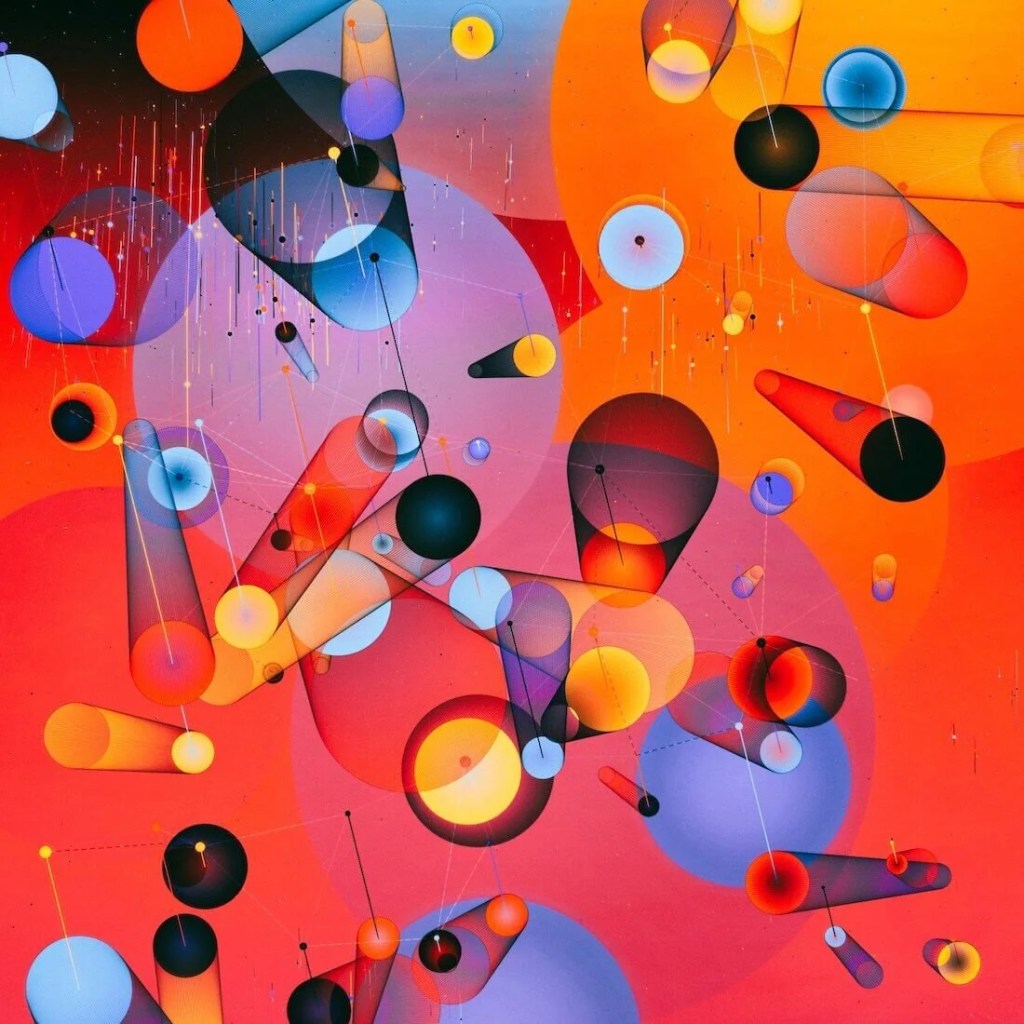
Abstract generative artwork created using algorithmic code with complex geometric patterns and vibrant digital colors.
Digital illustration is perhaps the most widely recognized form of digital art.
Using drawing tablets and stylus pens, artists create images that resemble traditional paintings or drawings. However, digital tools allow for remarkable precision and flexibility.
Artists can experiment with countless brushes, textures, and colors while working on multiple layers that can be edited independently.
This form of digital art is widely used in:
- publishing
- animation
- advertising
- video games
- concept design for films
Applications such as Procreate, Photoshop, and Corel Painter have become essential tools for professional illustrators. Photoshop, and CorelDRAW is what I have used countlessly.
Despite the technological medium, digital illustration still relies on traditional artistic skills such as composition, color harmony, and visual storytelling.
3D Digital Art and Virtual Sculpting
A digital artist sculpting a 3D character model using professional modeling software on a large computer screen.
Another significant category of digital art is the development of three-dimensional objects.
Using special software such as Blender and ZBrush, digital artists can create three-dimensional forms in much the same way that a sculptor works with clay or marble.
The digital sculpture can be rendered as a picture, animated, or even created in three-dimensional form through the process of 3D printing.
The 3D category of digital art has significant importance in the following fields:
- Film And Visual Effects
- Architecture
- Industrial Design
- Video Game Development
- Virtual Reality Environments
In many cases, people are unaware that they are interacting with digital art.
The beautiful environments of modern video games and films are the work of digital sculptors and modelers.
Generative and Algorithmic Art
Generative art has a different philosophy of creativity.
Rather than creating a single piece of art by hand, an artist creates a system or algorithm that creates a visual output.
This can include random elements, mathematical processes, or changing rules. This means that each output can be different.
Generative art can come out of creative coding, which is a form of art that uses a programming language.
This creates a philosophical argument about ownership.
Who is the real creator of a piece of art if an artist creates an algorithm and a computer creates a visual output?
Some artists see generative art as a collaboration between the imagination and logic.
Artificial Intelligence and Machine Learning Art

AI-generated digital artwork with surreal futuristic aesthetics created using artificial intelligence technology.
One of the latest technologies in digital art is the use of artificial intelligence.
Machine learning technology has the ability to learn from large sets of image data and then create new images from textual descriptions.
Technology in this field allows users to create complex images just by writing a prompt.
However, this technology has caused a major controversy in the field of art.
Some artists believe that this technology has raised concerns about copyright and the originality of art. Despite this, one of the latest technologies in digital culture is AI art
NFT Art and the Blockchain Revolution

A collection of NFT artworks displayed in a digital gallery environment representing blockchain-based art ownership.
The most significant change in the digital art field was the advent of NFTs.
What is NFT?
NFT is an acronym for Non-Fungible Token. NFT is a special kind of token that is used on the blockchain network. This token proves that an individual owns a specific asset.
For many years, it was not possible for an individual artist to sell his or her digital artwork. This was because it could be reproduced an infinite number of times.
The introduction of NFT technology allowed for the concept of digital scarcity. An individual could now create an artwork that was connected with a token that could prove ownership of the artwork.
The art market was shocked when an NFT artwork by Beeple sold for $69 million in 2021. The artwork was titled Everydays: The First 5000 Days. This was an immense digital collage.
The sale of the artwork showed that it was possible for digital artwork to have the same economic value as any other artwork.
However, the NFT boom has also attracted criticism. Concerns have been raised about environmental impact, market speculation, and copyright disputes.
Despite these challenges, blockchain technology continues to reshape the economics of digital creativity.
The Tools Behind Digital Art
Digital art is made possible by an ecosystem of hardware and software technologies.
Artists often combine multiple tools to create complex digital works.
Hardware may include:
- drawing tablets
- high-resolution displays
- graphics processing units
- virtual reality headsets
Software platforms provide the creative environment in which digital artworks are produced.
Programs such as Adobe Creative Cloud, Blender, and ZBrush have become essential components of professional digital studios.
These tools enable artists to simulate lighting, textures, materials, and motion with extraordinary realism.
Digital Art in Museums and Galleries
Digital art is no longer limited to personal computers or online spaces.
Museums and galleries worldwide feature digital art installations, immersive experiences, and interactive pieces.
Large-scale projections can turn entire architectural spaces into dynamic visual experiences.
Interactive pieces encourage the audience to influence the artwork by movement or touch.
Some museums have even started collecting NFTs and blockchain-based artworks as part of their permanent collections.
All of this points to the fact that digital art is being completely incorporated into the history of contemporary art.
The Future of Digital Creativity

A digital artist wearing a VR headset creating immersive three-dimensional artwork in virtual space.
Looking into the future, it can be said that digital art will be influenced by a range of new technologies.
Virtual reality enables artists to create and exhibit digital art within a three-dimensional space. The audience can experience it by moving around as a participant rather than a passive viewer.
Augmented reality enables digital art to be embedded into a physical space.
Artificial intelligence is still advancing as a powerful creative tool.
Perhaps the most exciting idea is that of a metaverse, a network of virtual worlds that blend art, culture, and society.
In these worlds, digital art could be part of the architecture of a whole virtual city.
Conclusion
One of the most dynamic and transformative aspects of modern creative culture is digital art.
Computer experiments of the 1960s, NFT marketplaces, and AI systems of today – digital technology has always pushed the boundaries of what is possible.
But while technology has changed, the essential driver of artistic expression has always been the same: the need to convey ideas, emotions, and visions of the world.
As technology advances, so will the relationship between artists and machines – the next chapter of innovation.
Digital art represents one of the most important transformations in the history of creative expression. As technology continues to evolve—from artificial intelligence to immersive virtual environments—the boundaries between artist, machine, and audience will continue to blur. What remains constant, however, is the human impulse to create, communicate, and imagine.
Digital art is not the replacement of traditional; rather, it adds another powerful dimension to the history of human creativity, an expansion of the artistic universe.
Image Source:
Ugee
piratesh.github
creativeblog
maxon
AIArtists.org
Photomatic AI – FlowHunt
elements.envato
Euronews

Leave a comment